







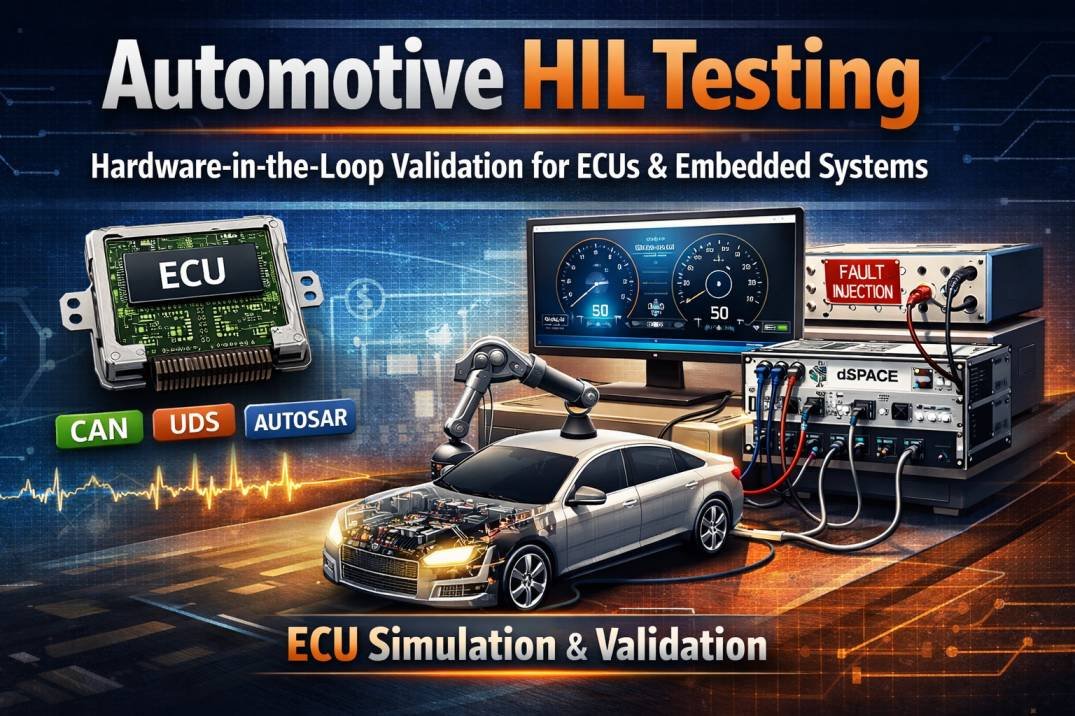
Automotive HIL Testing: Hardware-in-the-Loop Validation for ECUs & Embedded Systems
Instructor
About This Course
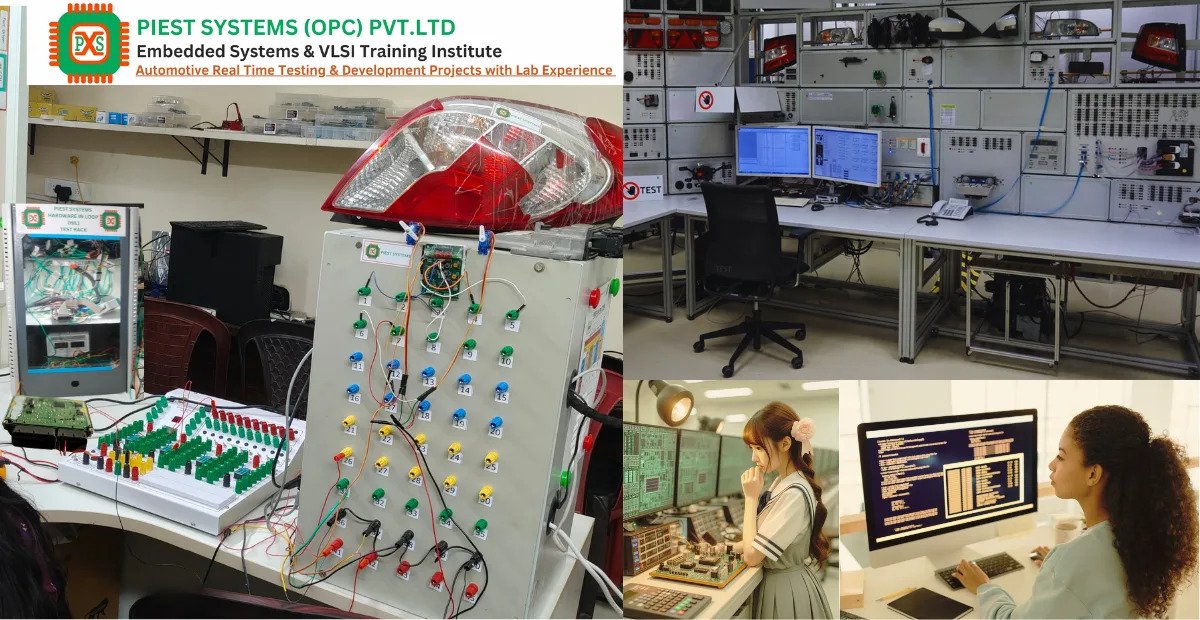
Automotive Hardware-in-the-Loop (HIL) Testing is one of the most critical validation techniques used in modern vehicle development to ensure that Electronic Control Units (ECUs) function correctly, safely, and reliably before being deployed in real vehicles. As automotive systems become increasingly software-driven and complex, HIL Testing has become an essential part of the development and validation lifecycle for OEMs and Tier-1 suppliers.
This course is designed to provide a complete and structured understanding of Automotive HIL Testing, starting from fundamental concepts and gradually progressing to industry-level testing workflows. It is suitable for beginners, fresh graduates, and professionals who want to enter or transition into automotive testing and validation roles. No prior experience in HIL systems or automotive testing is required, as all concepts are explained from the ground up.
You will begin by learning the core principles of HIL Testing, including HIL architecture, real-time simulation, plant models, signal conditioning, and ECU interfacing. The course explains how real ECUs are connected to a simulated vehicle environment to validate functionality without the risks and costs associated with road testing. Special emphasis is placed on understanding why HIL Testing is used, where it fits in the V-Model development process, and how it supports early defect detection.
As the course progresses, you will gain insight into automotive communication protocols such as CAN, LIN, FlexRay, Automotive Ethernet, and diagnostic protocols like UDS and OBD-II, all within the context of HIL Testing. The course also introduces test case design, fault injection, automation concepts, and regression testing, which are widely used in production HIL setups.
In addition, the course covers functional safety awareness, including how HIL Testing supports ISO 26262 activities, safety validation, and failure scenario analysis. Real-world examples and industry terminology are used throughout the course to ensure learners gain practical and job-relevant knowledge.
By the end of this course, learners will have a strong conceptual foundation in Automotive HIL Testing, enabling them to understand real HIL systems, communicate confidently with industry professionals, and prepare effectively for roles in automotive testing, validation, and embedded systems engineering.
Requirements

Trusted Companies
+3200 Companies trusted our courses for their staff tutoring
FAQ
Check the frequently asked questions about this course.
Sheema Nishath RK

Curriculum Overview
This course includes 13 modules, 69 lessons, and 0 hours of materials.
This lesson explains the basic concept of HIL testing and how it allows engineers to test ECUs in a virtual vehicle environment. You will learn how real hardware is combined with software-based simulation.
You will understand why road testing alone is not enough and how HIL helps reduce risk, cost, and development time while improving software quality.
This lesson compares Model-in-the-Loop, Software-in-the-Loop, and Hardware-in-the-Loop testing so you know where HIL fits in the ECU development lifecycle.
Learn how HIL is used during ECU integration, validation, and final release to ensure the ECU behaves correctly in all conditions.
You will learn what real-time simulation means and why timing accuracy is critical when validating automotive control systems.
This lesson introduces Electronic Control Units and explains how they control different vehicle functions such as engine, brakes, airbags, and ADAS.
You will learn how ECUs interact with sensors and actuators and why these signals must be accurately simulated in HIL testing.
This lesson explains how ECUs use software algorithms to process sensor data and generate control outputs.
You will understand different types of ECUs used in modern vehicles and their specific roles.
Learn how ECUs are connected through vehicle networks and power systems.
This lesson covers the major components of a HIL system including ECU, simulator, I/O, and communication networks.
You will learn how real-time simulators run plant models and generate sensor and actuator signals.
This lesson explains how physical signals such as voltage, current, and frequency are adapted for ECU testing.
You will learn how ECUs are physically connected to the HIL system.
This lesson explains how timing errors affect ECU behavior and how synchronization is maintained.
You will learn what NI LabVIEW is and why it is widely used in HIL testing.
This lesson explains how LabVIEW executes code in real-time to match vehicle behavior.
You will learn how to simulate temperature, speed, and position sensors.
This lesson covers how actuator outputs like motors and valves are modeled.
You will understand how a vehicle or subsystem is mathematically modeled.
Learn how to generate and observe signals in LabVIEW.
You will learn the basics of CAN communication used by automotive ECUs.
This lesson explains how data is structured and transmitted over CAN.
Learn how PCAN hardware connects the ECU to your computer.
You will use PCAN View to monitor and send CAN messages.
This lesson shows how to exchange real ECU data over CAN.
You will see how ECUs communicate in a HIL environment.
This lesson explains what TESAF is and how it supports ECU testing.
You will learn how to connect hardware and software for diagnostics.
This lesson introduces diagnostic services like Read, Write, and Routine Control.
You will retrieve live data from the ECU.
Learn how to safely update ECU software.
You will observe ECU responses during testing.
Learn how requirements are converted into test cases.
You will create structured test steps.
This lesson teaches how to verify ECU responses.
Learn how extreme values are tested.
Understand how tests are documented.
Simulate broken or incorrect sensors.
Test how ECUs handle failed actuators.
Introduce communication errors.
Observe ECU reaction to faults.
Measure how well the ECU handles failures.
Understand why automation is required.
Learn how to run multiple tests automatically.
Execute large test sets.
Analyze pass/fail results.
Ensure new software does not break old features.
Learn why safety is critical in vehicles.
Understand the automotive safety standard.
Learn how safety is managed from design to release.
Understand what must be protected.
See how HIL verifies safety logic.
Learn how ADAS works.
Test safety-critical control.
Understand sensor-based ADAS.
Simulate motors and inverters.
Test EV battery control.
Understand industry structure.
Learn how testing is planned.
Prepare professional reports.
Learn how ECUs are approved.
Understand industry standards.
Create a real HIL bench.
Generate realistic inputs.
Exchange CAN data.
Perform ECU operations.
Verify system performance.
Produce industry-style documentation.
Course Certificate
This Course Includes
Course Specifications


Send Course as Gift
Tags


Subscribe to Our Newsletter


Additional Links
Login Register Contact Certificate Validation Become Instructor About Terms and PoliciesContact US




Reply to Comment